
The Business Case
People ages 50 and older log more screen time than any other age group. According to Nielsen’s 2025 report Defying Media’s Gravity, adults ages 50–64 spent an average of 5 hours and 24 minutes watching television, including streaming, on days they watched TV in September 2024. Adults aged 65–99 watched even more, averaging 6 hours and 33 minutes per viewing day. This audience is not confined to traditional broadcasts, either. AARP’s 2025 technology trends research found that streaming adoption among people 50 and over climbed from 64% in 2019 to 86% in 2023, with the oldest viewers posting the sharpest gains. With respect to film, a 2025 AARP study found that “the 50-plus age group spends over $10 billion a year on Hollywood entertainment, with 61 million attending movies and over 84 million subscribing to streaming services in the last year.”
What to do:
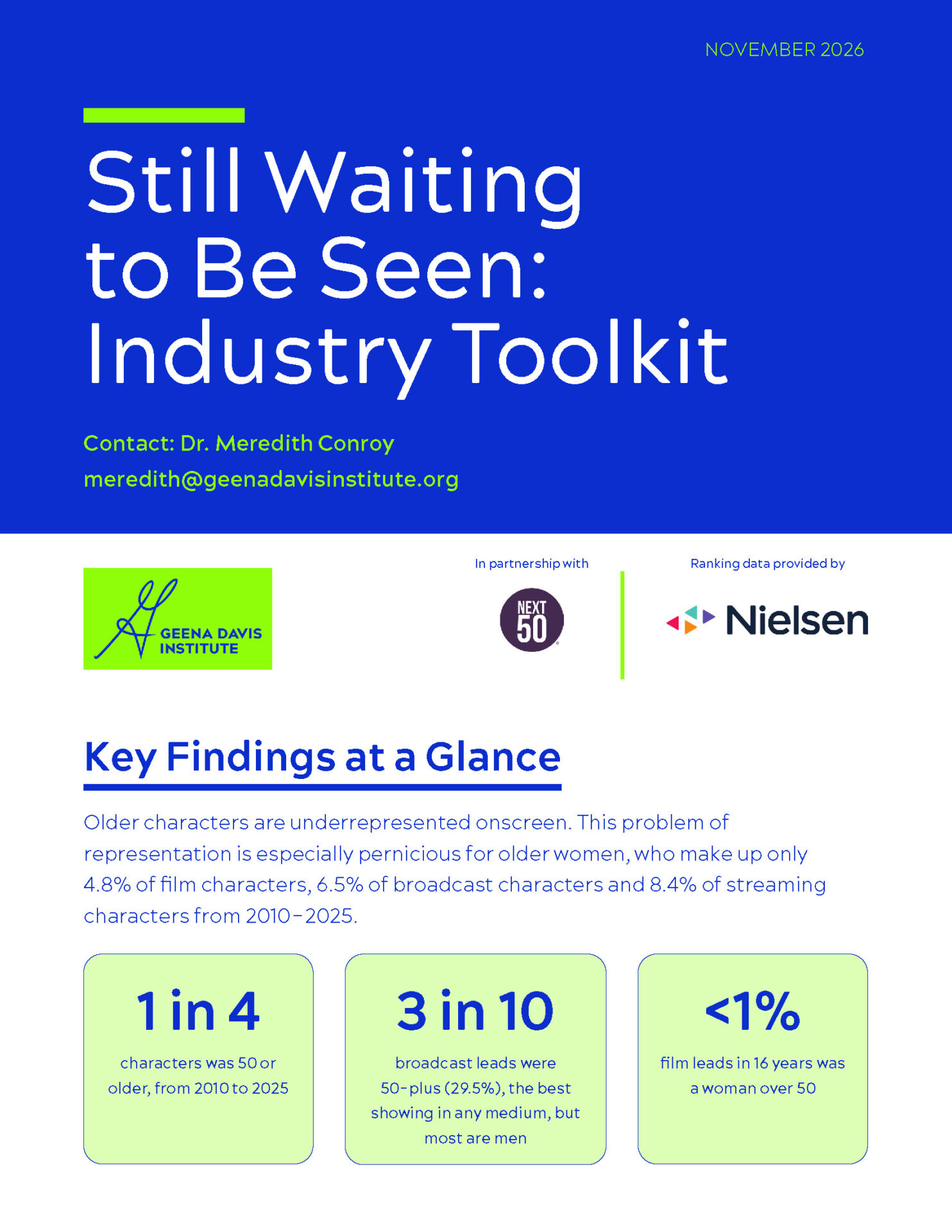
- Greenlight stories led by 50-plus women. In 16 years of top-grossing films, just one was led by a 50-plus woman. That’s a big audience nobody is writing for, and it spends more time watching than any other age group.
- Treat age as a standard casting decision in every genre. Broadcast already shows it works: nearly a third of its leads are 50-plus, the most of any medium. Fifty-plus casting shouldn’t be saved for specific genres or themes.
- Develop for the streaming audience you already have. Streaming adoption among people 50 and over reached 86%, but 50-plus women hold just 3.3% of streaming leads, even though they’re 8.4% of streaming characters.
A Showrunner Checklist
Representation is decided long before release: in the writers’ room, the casting session and the script notes. Fifty-plus characters are already on screen, about one in four, but too often they’re the villain, the punchline or the one cheering on someone else’s story. These steps help make sure 50-plus characters, and 50-plus women especially, get stories of their own.
What to do:
- Apply the Next Fifty Test before cameras roll. Use it at the script and casting stages, not just after release, to check whether 50-plus women have goals and stories of their own.
- Make 50-plus casts as diverse as younger ones. People of color are 23% of 50-plus film characters, compared with 32% of characters under 50. None of the 26 film leads who were 50-plus was a woman of color. Don’t let “older woman” default to white or “older person of color” default to male; treat gender and racial diversity as one goal.
- Show 50-plus women at work and in charge. Fifty-plus characters who work are about twice as likely to hold authority, so write that authority alongside vitality, romance and friendship in the same character.
| Watch for | Try instead |
|---|---|
| Older characters as villains | Ask whether a villain’s age is part of the story or just a default. Cast 50-plus actors as protectors, problem solvers and heroes. |
| Older characters without love lives | Give 50-plus characters romance, intimacy and everyday affection, and don’t play it for laughs. Right now they’re less than half as likely as under 50 characters to be shown being affectionate (e.g., 9.3% compared with 19.9% in film). |
About the Study
This study examines the representation of adults ages 50 and older across popular U.S. film and broadcast television from 2010 to 2025, as well as streaming from 2013 to 2025. The sample includes 160 top-grossing films, 160 episodes of top-rated broadcast series, and 120 episodes of popular streaming series. In total, the study analyzes 440 titles and 10,504 speaking characters.
How to cite this study
Conroy, M., & Espinoza, C. (2026). Still Waiting to Be Seen: Fifty-Plus Characters in Film, TV and Streaming, 2010–2025. The Geena Davis Institute.
Check out our other reports on aging and older adults below
- Seventy Years of Fifty-Plus Actors at the Emmys Gender Gaps in Nominees and Winners (2026)
- Missing in Action: Writing a new narrative for women in midlife on the big screen (2025)
- Fifty-Plus Female Actors Are Recognized Less Than Their Male Counterparts (2025)
- Aging in Play: Representations of Age in Video Games (2025)
- Women Over 50: The Right to be Seen on Screen (2020)
- Beyond the Stereotypes: The Reality of Aging Women in Films (2020)