Nokia Bell Labs and the Geena Davis Institute unite the Hollywood and tech industries to inspire the next generation in tech. Nokia Bell Labs is the award-winning industrial research arm of Nokia focused on creating innovative technologies that address human needs and have a demonstrable impact on industry and society.
Nokia Bell Labs recognizes that positive media representation in tech is paramount to changing societal attitudes regarding working in tech, which is why part of its 100th birthday celebration included the “Hollywood Summit: Advancing Women in Tech” on February 13. The dynamic gathering at The Ebell of Los Angeles was born from a partnership between Nokia Bell Labs and the Geena Davis Institute.

“Creating the opportunity for key people from media and tech to meet and discuss how we can excite people about pursuing careers in tech is the purpose of the event,” Thierry Klein, the President of Nokia Bell Labs Solutions Research said on stage. “It is of strategic importance for businesses and industry to create a larger and broader talent pool. Studies have shown that teams with varied perspectives are more productive, deliver more novel results and deliver higher-quality research outputs.”
“If you’re looking to hire the best team to solve the hardest problems in the world, we need the broadest talent pool. We believe media can help foster the growth of the next generation of innovators who are driving technological advancements that will positively impact the world. “
Historical Figures Who Paved the Way for Women in Tech
Anne Y. Lee is a Bell Labs Fellow with a distinguished 37-year career in tech. Lee currently works as a Senior Researcher in AI at Nokia Bell Labs Solutions Research. Lee, an experienced keynote and TEDx industry speaker, is passionate about the history of tech.
“It’s important to understand and remember, Lee said, the history of computing.” “We’ve had human ‘computers’ going back to the 1600s. The word ‘computer,’ in fact, originally referred to mathematicians who did calculations for a living. We’ve had groups of ‘computers’ at Bell Labs right from our founding in 1925, similar to the groups of human computers depicted in the movie, “Hidden Figures.”

Lee noted that in 1946, the six original programmers of the first electronic computer, the ENIAC, were previously working as human computers. The six were: Betty Jean Jennings Bartik, Betty Snyder Holberton, Kathleen McNulty Mauchly Antonelli, Marlyn Wescoff Meltzer, Frances Bilas Spence, and Ruth Lictherman Teitelbaum.
Some of the human computers, turned computer programmers, would later go on to found their own software companies. ENIAC programmer, Elsie Shutt, is an example. Her 1957 company was dubbed “The Pregnant Programmers” by Businessweek Magazine.
Other early computer pioneers include Grace Hopper who invented the compiler and popularized the term ‘computer bug,’ and Maragaret Hamilton who led the development of software for the Apollo 11 mission landing humans on the moon and coined the term ‘software engineering.’ At Bell Labs, Erna Schneider Hoover received one of the first software patents ever issued. Vladmir Vapnik, Corinna Cortes and Isabelle Guyon created AI support vector machines while Ken Thompson and Dennis Ritchie invented the widely used UNIX operating system and C programming language.
With a nudge from Nokia Bell labs and the Geena Davis Institute, there’s hope that more young people will recognize how they can positively impact the world through careers in tech.
The Impact of On-Screen Role Models in Shaping Tech Careers – “If They Can See It, They Can Be It”
When the Geena Davis Institute surveyed 1,000 individuals about the importance of representation of STEM characters on screen, one question found almost universal agreement.
Asked to name a character who directly influenced their interest in STEM, more than 77 percent cited Penelope Garcia from the CBS drama “Criminal Minds.”

Nobody loves that statistic more than Kirsten Vangsness, the actor who has portrayed Penelope, the relentlessly vibrant FBI technical analyst, since the series premiered in 2005.
“It just made my heart sing,” Vangsness said during the recent event organized by Nokia Bell Labs and the Geena Davis Institute at the Ebell of Los Angeles.
“There’s a quote from Toni Cade Bambara:
‘The role of the artist is to make the revolution irresistible’- and that’s what I wanted to do. I wanted to make that character irresistible. I wanted to make it fun to be smart.”
For on-screen inspiration, Anne Lee also points to “Hidden Figures” starring Taraji P. Henson, Octavia Spencer, and Janelle Monae. The 2016 film spotlighted these three mathematicians who played a pivotal role in astronaut John Glenn’s launch into orbit in 1962. Authentic portrayals such as in that film can play a powerful role in reshaping cultural tropes. When young people see characters that they resonate with succeed in tech on screen, whether it is real-life individuals from history, like those in Hidden Figures, or cool and capable fictional characters like Penelope Garcia in “Criminal Minds”, Dana Scully in the “X Files,” or Angus MacGyver and Riley Davis in “MacGyver”, then they themselves are encouraged to plan their own careers in tech.
Tech Innovators and Hollywood Creators – Educating Audiences Together
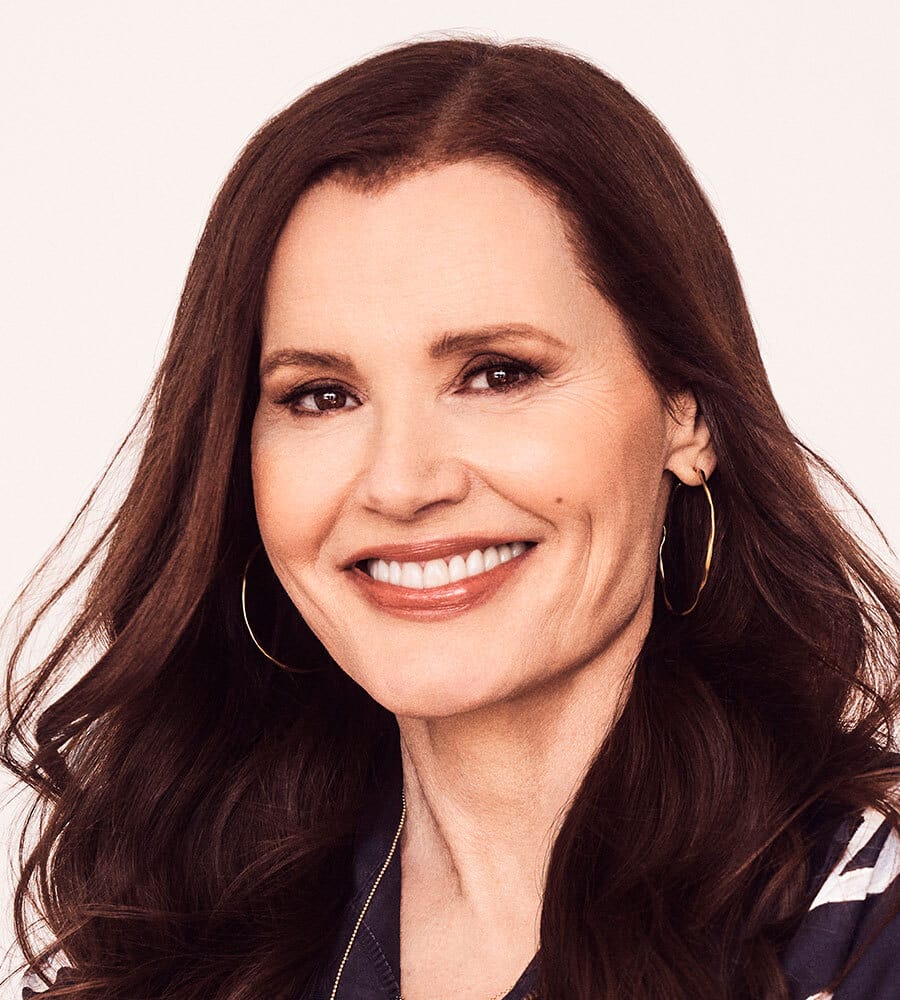
Geena Davis, the two-time Academy Award winner and founder/chair of her namesake non-profit, has long advocated for broad representation on screen. Davis set the tone for the Hollywood Summit by congratulating Nokia Bell Labs for “100 years of groundbreaking research, advancing communications, computing, and the internet in ways that have transformed our world.”
Geena then welcomed an extraordinary lineup of speakers from across the science, technology, media, and content creation sectors.
“You are united by a commitment to addressing an issue deeply important to me: How can we more effectively portray women working in technology on screen to inspire future generations off screen?” Davis said.
“Because when we see women striving in STEM in the stories we watch, it changes perceptions and breaks down barriers. It sends a powerful message to young girls everywhere that they belong in these fields.
There is much work to be done. Madeline Di Nonno, the President & CEO of the Geena Davis Institute, noted that in more than 15 years of tracking data on female STEM characters on screen, there is little change.

The lack of progress is complicated by the fact that most of those characters are limited to the field of medicine. “We have a lot of doctors,” Di Nonno said on stage.
What we’re not seeing, Di Nonno added, are more portrayals of women in mathematics or computer science. Di Nonno noted the rapidly expanding cybersecurity sector, where thousands of jobs are awaiting qualified applicants.
Di Nonno read a quote from Mae Jemison, a doctor, chemical engineer, and former NASA astronaut:
“The difference between science and the arts is not that they are different sides of the same coin even, or even different parts of the same continuum, but rather, they’re manifestations of the same thing…They spring from the same source. The arts and sciences are avatars of human creativity.”
Tech Role Models: Real Life Innovators Inspiring the Next Generation
This is where compelling representation can help shift the narrative. In a recent GDI survey:
- 71 % of respondents said female tech characters on screen matter.
- 62% of girls and young women enjoy tech-related movies and TV shows.
- 72% wish there were more female tech characters in entertainment.
Kari Byron has seen the power firsthand. As a longtime host of “MythBusters,” the hit show in which science took on urban legends, Byron found herself an unlikely tech advocate.”
“I got to see the impact and ripple effect that “MythBusters” had because it was being used in schools as a way to teach science,” Byron said. “And over the years, I’ve had parents come up to me and say, ‘My child is an engineer because they watched you get so excited on MythBusters.’ Or young people would say, ‘ I decided I wanted to be a chemist because I liked watching you blow stuff up!’ And I really, really enjoyed seeing that impact of inspiring young people to see science and STEM differently.”
Debbie Sterling, the founder and CEO of GoldieBlox, told the audience that her favorite show as a young child was “Inspector Gadget.”
So Sterling decided to create her own fictional tech character. Sterling, who received an Engineering degree at Stanford University in 2005, quickly discovered an untapped market upon founding GoldieBlox about 10 years ago. The award-winning children’s multimedia company challenged stereotypes.
“It went viral right away,” Sterling said. “People were like, ‘Huh, why is the world this way? We want more for our children.”
Sara DeWitt is the Senior Vice President and General Manager for PBS Kids, which showcases STEM-themed programming such as “SciGirls,” the upcoming “Weather Hunters” and “Lyla in the Loop.”
The network does so in part because its partnership with the Geena Davis Institute allows the masterminds at PBS Kids to understand the impact of their work.
“It’s very clear in the research that if a child sees a positive representation of someone who looks like them, they will have higher self-esteem and they will have better success in school,” DeWitt said.
Award-wining filmmaker Valerie Weiss grew up in Philadelphia with a dramatic bent and, as a 10th-grader, had a teacher who taught biology by making it the most compelling story in the world. Hooked, Weiss went on to earn a Princeton degree in molecular biology before getting a PhD. in biophysics from Harvard.
Weiss is now, as Di Nonno put it, “a scientist who makes movies.” Weiss’s films include “Losing Control,” The Archer” and “A Light Beneath Their Feet.”
People sometimes ask how Weiss could get involved in science and filmmaking, two disciplines that seem so different.
“But, really, they’re the same for me,” Weiss said. “I realized that as a kid what I loved about acting was figuring out the subtext. Like, why do characters do what they do? Why is someone exhibiting behavior that makes no sense? Why does someone we love not love us anymore?’ Those were the questions I was really interested in as an actor.”
“And then when I took this biology class . . . it was amazing because suddenly I understood molecules might be why we do what we do. Genetics, evolution, our habitat – all inform behavior. And I could see sort of this bigger spectrum of influence on why we do what we do and to me it just helped me not judge people as much, instead get curious.
Bridging the Gender Gap: The Role of Authentic Media Portrayals
Savita Raj, the CEO for Techbridge Girls, was asked about studies that show girls are equally interested in science and technology at young ages but some tend to “self-select” themselves out of those flelds by middle school or junior high.
Why does that happen?
“The million-dollar question,” Raj replied.
Raj said that girls’ confidence in STEM fields peaks at age 9 and will fade “without intentional support and intentional investment in girls,” Raj said. A key is to show girls how science is their pathway to changing the world, an avenue for addressing world hunger or climate change.
Beyond that, Raj said, it is vital for girls to learn about all the different scientists and engineers who have shaped technology for centuries.
“We need to tell them the STEM lineage so girls know they belong,” Raj said.
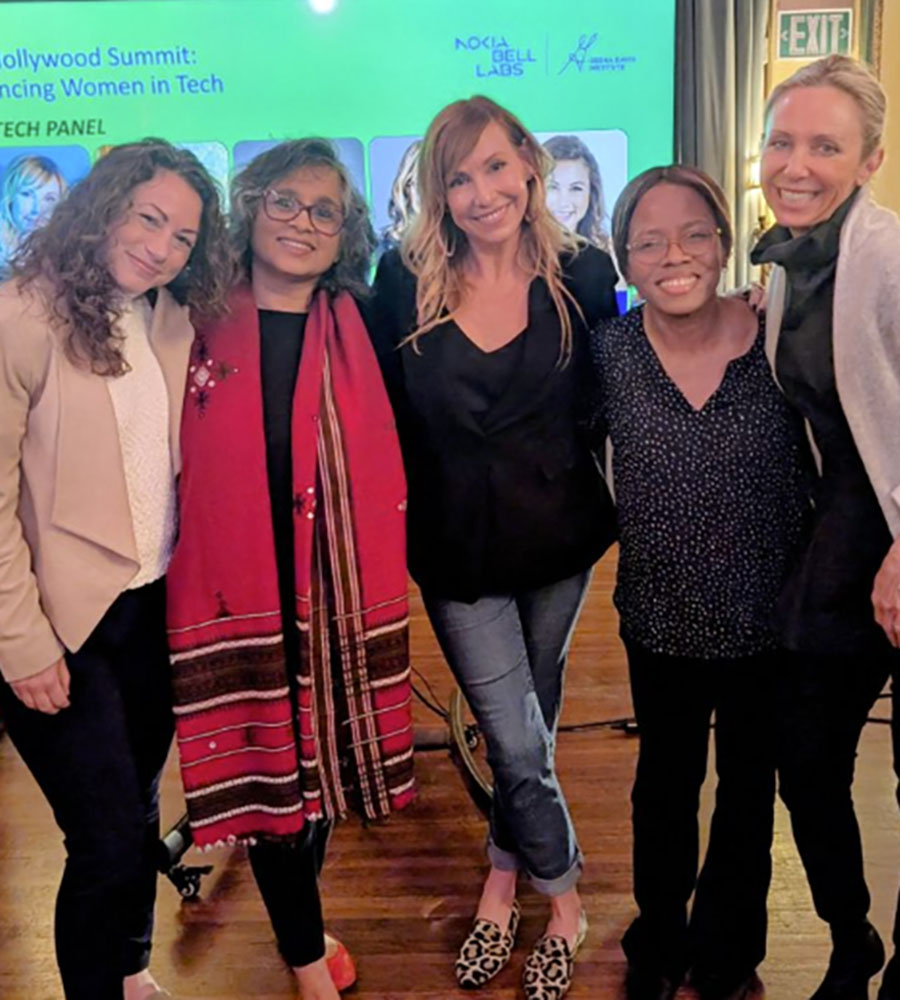
Hollywood can take inspiration from the Summit’s panelists as models for new tech characters: Kari Byron, Savita Raj, Debbie Sterling, Shannon Gilmartin (Director of the Stanford VMware Women’s Leadership Innovation Lab), and Susanne Tedrick (Technical Customer Solutions Manager, Amazon Web Services) are just a few examples of real-life individuals working in tech whose engaging personalities and impactful careers exemplify the unlimited opportunities available to those who choose jobs in tech.
The Future of Tech: Why Representation Must Evolve
Fittingly, this event took place at The Ebell of Los Angeles, which was founded “to interest women in the study of all branches of literature, art, and science and the advancement of women in every branch of culture.”
It’s essential that we continue to create space in this field for everyone,” said Meredyth Deighton, the director of membership and programming for the venue, “ensuring that all have a voice in shaping the future of technology.”
For Anne Lee, this is long overdue. “The rapidly expanding and ongoing AI revolution crystalizes the huge impact that the tech profession continues to have and has had on every aspect of how humans live. We need the population of tech workers to capture the varied perspectives of the entire population that benefits from the technology being developed. Positive media representation of all people in tech is paramount to changing societal attitudes and ultimately increasing the talent pool.”
Join the Movement:
Nokia Bell Labs and the Geena Davis Institute are working together for better onscreen representation in tech. See the Hollywood Summit on YouTube and learn more about the panelists’ bios on our event page. Knowledge is power – explore GDI’s Research.