
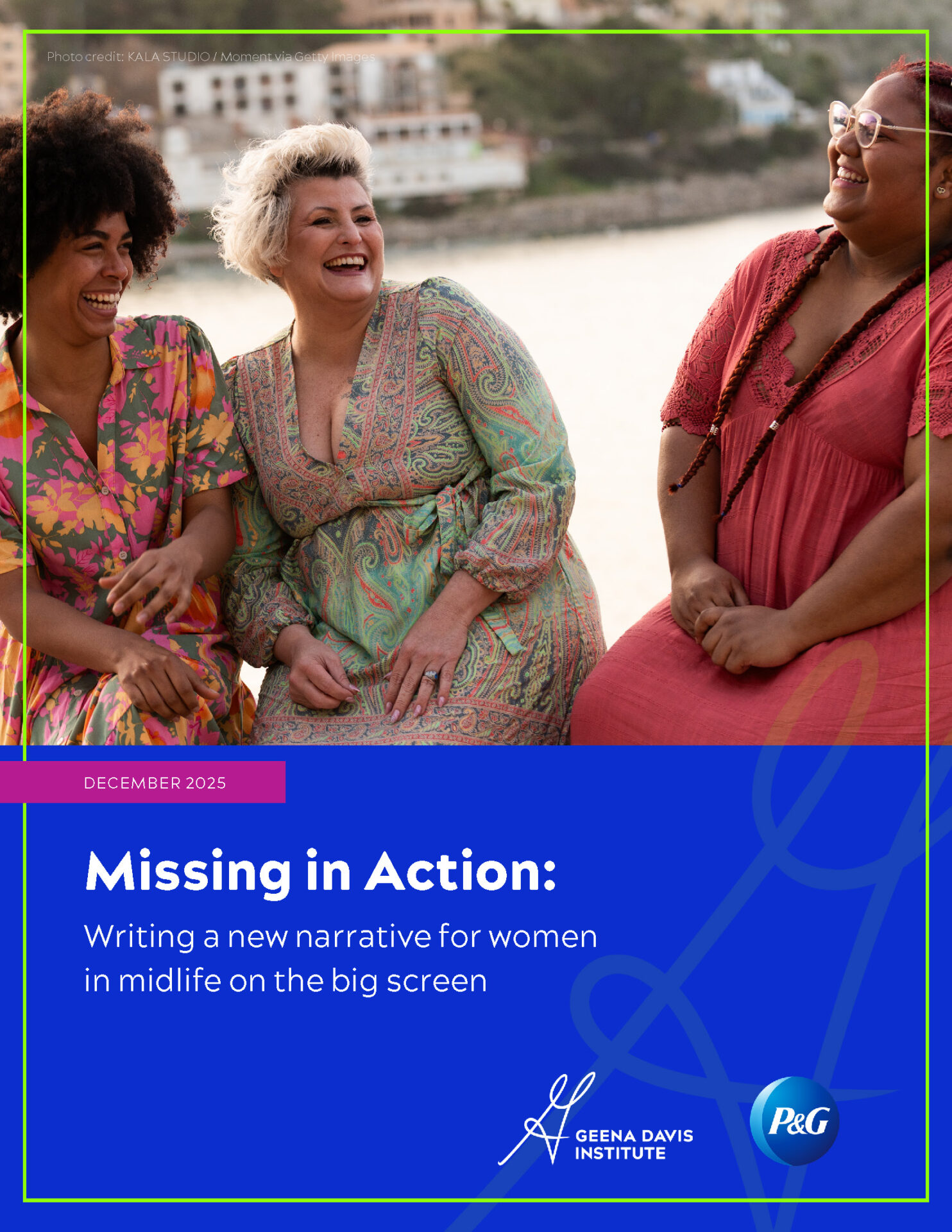

This report, sponsored by Procter & Gamble, investigates the degree to which top-grossing domestic films have featured menopause, and how these narratives play out on the big screen. Analysis from 2009 to 2024 provides a series of benchmarks for understanding how the media environment has and hasn’t evolved on the topic.
Beyond menopause, the report also considers larger aging narratives related to work, love, caregiving, health, and physical appearance, thereby revealing how aging more broadly is framed differently by gender, and how that may shape audience expectations about relevance, desirability, and personal fulfillment later in life. By analyzing all characters who were 40-plus across a sample of the top-grossing domestic films over 16 years, we identified patterns that reveal persistent age gaps in storytelling for men and women.
In addition to this analysis of 16 years of top-grossing domestic films, this study includes a nationally representative survey of adults of all ages in the U.S., asking them about their perceptions of menopause on screen and their opinions about what they want to see more of.In this executive summary, we highlight key findings from the film analysis and the survey, but we invite you to read the entire report for a fuller picture of the on-screen representation of menopause — and where it can go from here.
Key findings from the film study
- Menopause is nearly invisible: Of the 225 films prominently featuring a 40-plus female character released between 2009 and 2024, only 6% (or 14 films) mentioned menopause. These mentions were usually side comments. Only one film featured a prominent menopause storyline.
- Menopause storylines aren’t more common in more recent years. Of the 14 films that mentioned menopause, 11 came out between 2009 and 2016. Since menopause was often used as a comedic device, its decline in later years may reflect the fact that 40-plus female characters were appearing in fewer comedies, pointing to a strong link between menopause mentions and comedy.
- Meno-rage as a punchline: In many films, menopause was used as a joke to explain women’s anger or mood swings, and even non-menopausal characters were assumed to be menopausal when they expressed anger. This is a pattern that shames menopause while also reinforcing stereotypes about women’s emotional volatility being due to biology.
- It’s not all hot flashes: Menopause was rarely mentioned, but when it was, films described a mix of accurate symptoms — like sweating, chin hairs, and changes in sex drive — and exaggerated or inaccurate ones — like startling easily. Hot flashes appeared in only three cases.
- Physical aging: While menopause storylines were uncommon, general aging narratives were more frequent; women ages 40 and older were twice as likely as men to have a narrative focused on physical aging (15% vs. 7%).
- Medical narratives: Medical narratives were also rare, but when characters received medical interventions, women were twice as likely as men to have these storylines (4% vs. 2%).
- Cosmetic treatments: Of 23 characters shown engaging in cosmetic treatments, 17 (74%) were women. Male characters’ treatments were minor (i.e., dye for graying hair, nose trimming, botox), while women’s treatments often involved surgery or fantastical interventions to restore youth (i.e., vaginal rejuvenation, brow lifts, liposuction).
- Parenting and occupation: Characters’ personal lives were also analyzed, and women ages 40-plus were more likely than men 40-plus to be parents (46% vs. 29%), while 40-plus men were more likely to have an occupation (72% vs. 53%).
- Sad widows: The Sad Widow/Widower Trope depicts a character defined by the loss of their spouse, with their narrative centered on grief and loneliness. In the 225 films we analyzed, 19 featured “sad widows,” compared with eight featuring “sad widowers,” suggesting aging is more often framed as a story of loss for women than for men.
Key findings from the survey
- Desire for better representation: Overall, 2 in 3 respondents (67%) agree on the importance of realistic portrayals of menopause on screen (72% men, 63% women). This signals a broad audience appetite for menopause stories that move beyond jokes or silence.
- TV and movies as the first source of menopause information: While many respondents turn to parents, doctors, and friends for menopause information, scripted entertainment still plays a notable role, especially as a first source of exposure to menopause. Fourteen percent of all respondents — but 21% of men, women under 40, and people of color — say TV/film was their first exposure to the concept of menopause.
- Media portrayals: Advertising and TV comedies are the most common media sources where respondents notice menopause (53% and 43%, respectively).
- Portrayal tone: Women are more likely than men to see on-screen portrayals as negative (40% vs. 31%), though some respondents noted that sitcoms normalize menopause through humor and character-driven storylines.
- Stereotypes: Most commonly portrayed traits include “normal phase of life,” “constantly experiencing symptoms,” and negative emotions, like exhaustion, anger, and depression; empowering or confidence-boosting portrayals are rarely seen, according to respondents asked to recall portrayals.
Recommendations for improving onscreen portrayals of menopause
- Shift focus from the medical model to the sociocultural model of menopause. Menopause is a multifaceted experience, not purely medical, and high-quality representations should capture this complexity rather than reduce it to physical or psychological symptoms. As Marilyn Muthoni Kamuru notes in her book Bloody Hell!: Adventures in Menopause from Around the World, the loudest narratives focus on “who we stop being — women who can reproduce” and highlight the importance of understanding menopause as women experience it, not just through medical discourse. Women should be portrayed with agency, navigating the transition on their own terms. Medical information can be included, but it should be free from misinformation, while psychological symptoms should be depicted with nuance, avoiding reductive stereotypes, such as “meno-rage.”
- Link menopause with acceptance, not resistance. Film often frames menopause as a sign of decline that the character either resists (like a character who clings to youth and sexuality) or gives in to (becoming less relevant or even human). There’s rarely a middle ground that portrays it as a normal, even liberating, phase of life.
- Show resources, not just deficits. One pitfall of the medical model is the tendency to view menopause through a lens of deficit — and sometimes even more negatively, using terms like decline, decay, and atrophy. Consider whether menopause storylines fall into this trap by focusing exclusively on negative symptoms or aspects of menopause. Work toward more affirming character arcs related to gender and aging — ones that suggest empowerment, accomplishment, or personal growth in some area, rather than ones focusing exclusively on decline. To combat negative stereotypes about the diminished social worth of menopausal women, depict female characters with healthy coping skills and personal resources, including social support offered by friends and family, rather than pitting the menopausal woman against those around her (e.g., a meno-raging woman against the world).
- Womanhood is more than reproduction. One of the more damaging narratives about menopause is that it “feels like the ‘finish line’ for women, whose value in society is being reduced to motherhood.” Avoid characterizations of menopause that conflate womanhood with fertility, and work to provide a more nuanced and less reductive portrayal of womanhood that treats older women as multidimensional, fully fleshed-out characters.
- Laugh with menopausal women, not at them. The menopause mentions we encountered in our content analysis were almost exclusively in comedies. Reducing menopause to the punchline of a joke further undermines the social status of menopausal women, reinforcing stale narratives intended to silence and shame women for their natural aging process. It’s important to avoid trading in medical misinformation just for a laugh as well, since these false claims are reinforced when repeated without correction.
How to cite this study:
Conroy, M., Cassese, E., & Espinoza, C. (2025). Missing in action: Writing a new narrative for women in midlife on the big screen. Geena Davis Institute.
To see similar reports on the representation of older and aging women onscreen, check out these: