
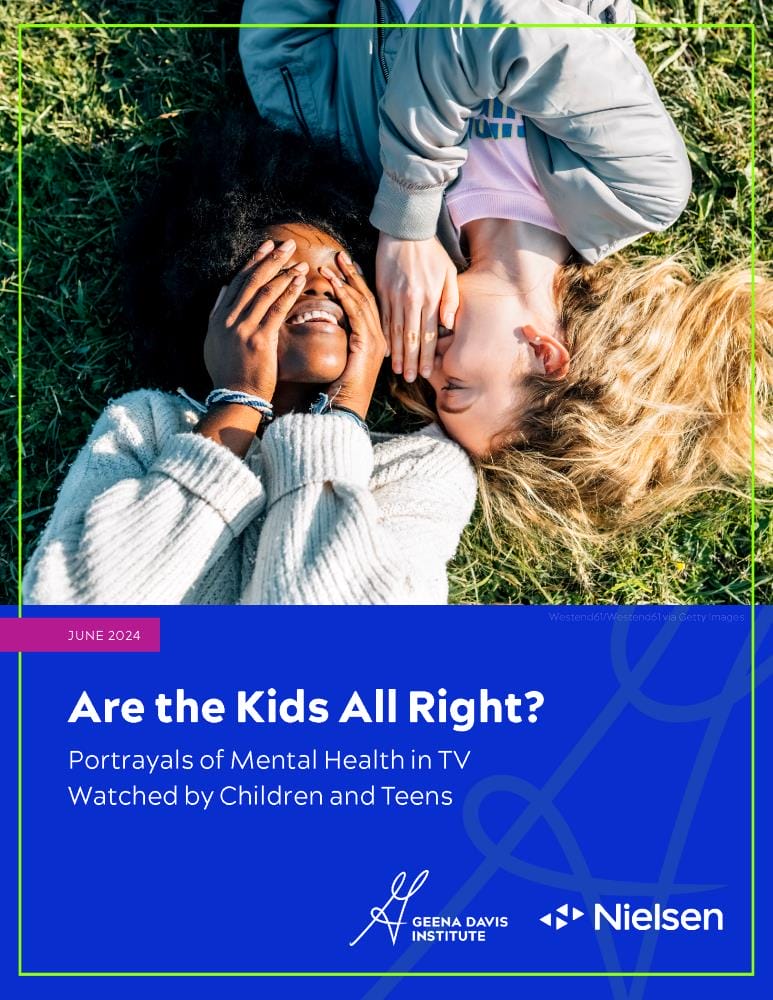

Young people in the U.S. are experiencing mental health struggles beyond what previous generations experienced, and we view television as a valuable intervention tool that can help us better understand and tackle these issues. Accurate representation of mental health on TV can help children and adolescents grasp and communicate their struggles to trusted adults, and minimize the isolation that can stem from mental health issues.
We analyzed the most popular English-language scripted television series (broadcast, streaming, and cable) in the U.S., in 2021 and 2022, for audiences ages 2 to 11 and audiences ages 12 to 17, according to Nielsen metrics. Support for this project was provided by Regina K. Scully and the Artemis Rising Foundation.
Key findings
- Mental health issues are underrepresented on TV shows that children and teens watch. In total, 17.4% of all episodes reviewed include at least one character with an explicit mental health issue.
- Characters with mental health issues on TV are rare. Only 1.3% of prominent characters have an explicit mental health issue; 2.1% of characters have an implicit mental health issue (implicit mental health issues are portrayals of mental health that are implied but not made explicit).
- Narratives neglected mental health issues in the LGBTQIA+ community. Although the mental health crisis uniquely impacts LGBTQIA+ individuals, we did not identify any LGBTQIA+ characters struggling with mental health issues in the episodes analyzed.
- Less than 2% of young people are shown with mental health issues. Among prominent characters, characters ages 50 and older are most frequently shown with an explicit mental health issue (3.5%), followed by children and teens (each 1.7%), and adults ages 20 to 49 (0.7%).
- Male characters are more likely to struggle with substance abuse. Among characters with explicit mental health issues, male characters are about twice as likely as female characters to struggle with substance use disorder.
- Female characters are more likely to have mood disorders and inflict self-harm. Among characters with explicit mental health issues, female characters are about 12 times as likely as male characters to struggle with self-harm and about three times as likely to struggle with mood disorders (e.g., depression, bipolar disorder).
- Female characters with explicit mental health issues are more than twice as likely as male characters to seek help. Half of female characters with explicit mental health issues engage in help-seeking behavior, compared with just 21.3% of male characters.
Recommendations
- Write more characters who struggle with mental health conditions. Representation makes people feel heard, understood, and validated. Bring more characters who struggle with any sort of mental health issue into narratives, so that children and adolescents can learn to recognize mental health issues in themselves and others. Narratives with characters who struggle with their mental health also lead parents to talk to their children about mental health.
- Think intersectionally when casting characters with mental health conditions. People in the U.S. who most report experiencing mental health conditions are girls and women, LGBTQIA+ individuals, and people of color. Feature characters representing these communities, including their intersections, struggling with mental health issues to reflect the real world and validate viewers’ real struggles.
- Don’t blame and shame. Storylines are an opportunity to explain various sources of mental health conditions that are outside of individuals’ control, such as societal expectations, insufficient public resources, unexpected events, and more. Narratives can also explore why many individuals do not recognize the warning signs and do not seek out help that does not suggest an individual moral failing.
- Make mental health portrayals explicit, intentional, and clear. Although mental health issues in general were not prevalent on screen, explicit mental health conditions were even less so. Rather than making mental health issues ambiguous, make them clear. Doing so can decrease stigma and taboos that limit honest conversations. Mention conditions by name, talk about what conditions entail, and bring it up in more than one episode in a series.
- Encourage children and adolescents to seek help. Television has the power to encourage positive behavior among young people, like seeking help for mental health conditions, or supporting their friends and family through their struggles. Consult with mental health professionals to realistically portray help-seeking behaviors that cater to children and adolescents.
How to cite this report:
Terán, L., and Conroy, M. (2024). Are the Kids All Right? Portrayals of Mental Health in TV Watched by Children and Teens. The Geena Davis Institute