
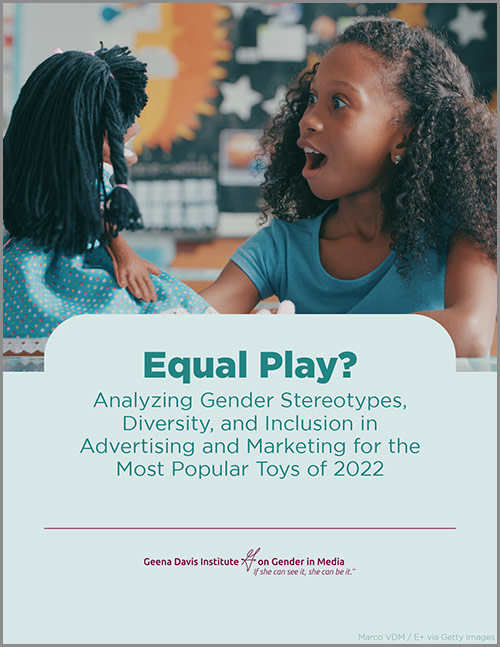
A four-year-old child sits on the floor of a living room, captivated by a bright television commercial. The ad shows energetic children racing remote-controlled cars through backyard mud, accompanied by heavy rock drums and loud voiceovers. A few minutes later, another ad features quiet pastel rooms where young girls gently comb doll hair. These marketing choices do more than sell products. They send immediate signals about who gets to invent, build, compete, or care. This Geena Davis Institute study, Equal Play? Analyzing Gender Stereotypes, Diversity, and Inclusion in Advertising and Marketing of Toys, examines whether top commercials still reinforce old boundaries or finally move beyond the gender binary.

Toys and games play a fundamental role in child development, helping young minds build social, emotional, and cognitive skills. As such, the need for a thorough examination of advertising and marketing of toys. Historically, manufacturers have color-coded products, segregated store aisles, and tailored commercials to convey rigid expectations about gendered tastes. Recently, parents have voiced growing concern across social platforms, questioning how these narrow messages limit children’s imaginations and life experiences.

Key Findings: Quick Overview

To evaluate current marketing practices, our team analyzed 175 advertisements for products listed as “best-selling” across Amazon, Target, and Walmart as of March 2022. The data shows that traditional gender tropes remain deeply embedded in commercial advertising:

  • Actor Demographics: Girls made up approximately 56% of featured child actors across ads for best-selling toys in 2022.
  • Domestic and Nurturing Tropes: Toys marketed to girls were 18 times more likely to depict nurturing or domestic skills compared to toys marketed to boys.
  • Aggressive and Competitive Messaging: Advertisements aimed at boys predominantly featured vehicles, sports gear, and toy weapons. These spots relied on faster music, higher audio volume, and masculine language.
  • Competitive Play Gap: Boys accounted for 75% of characters engaged in violent or competitive play scenarios.
  • STEM Skill Parity: Children of all genders appeared in basic learning and STEM toy commercials at virtually identical rates.

Analyzing Domestic Tropes, Competitive Tropes, and STEM Parity

The gap between girl-targeted and boy-targeted marketing reveals two very different developmental worlds. When advertisers frame caretaking as an exclusively female activity, they tell young boys that empathy and domestic care are unnecessary skills. Conversely, when commercials portray active adventure or physical competition as strictly male domains, they discourage girls from pursuing risk-taking and athletic play.

Fortunately, the data offers a clear sign of progress in educational marketing. Children across all gender identities appeared in STEM and basic learning ads at similar rates. This parity demonstrates that when advertisers consciously remove gender labels from problem-solving toys, kids of all backgrounds are invited to build, invent, and experiment.

Industry Next Steps for Inclusive Commercial Production and Marketing

Brand managers, creative directors, and marketing executives hold enormous power to shape healthy play environments. To create inclusive campaigns, production teams can follow several practical steps:

  1. Balance Play Styles Across Genders: Show boys using play kitchens, dolls, and nurturing sets, while showing girls leading high-energy sports, racing, and adventure games.
  2. Standardize Audio and Visual Cues: Eliminate hyper-masculine audio track overlays for boys’ products and soft pastel framing for girls’ products, adopting energetic presentation styles for all kids.
  3. Expand Cooperative Play Narratives: Depict diverse groups of children collaborating on projects rather than defaulting to aggressive competition in boy-targeted campaigns.
  4. Maintain STEM Equal Access: Continue featuring girls and boys together in science, math, and robotics commercials without color-coding the physical packaging or sets.

Supporting Research for Inclusive Child Development Media

Rigorous media research provides brands with actionable insights to modernize their advertising strategies. At the Geena Davis Institute, we work directly with global entertainment and marketing leaders to ensure commercial messaging reflects the true diversity of modern families.

Support our ongoing media research to help dismantle restrictive marketing tropes and Donate to the Geena Davis Institute today to advance inclusive storytelling across children’s advertising.

Photo credit: Marco VDM/E+ via Getty Images