
The Golden Globes have a golden opportunity.
In an era when truth is harder to pin down than ever, it’s time to honor the documentary filmmakers whose work serves as the most trusted source of information in the media landscape.
Indeed, there is a growing industry push for the Globes to add a Best Documentary category and push these incredible creative works further into the spotlight.
Prominent advocates behind the charge include Regina K. Scully, the founder & CEO of Artemis Rising Foundation, Geralyn White Dreyfous, the co-founder of Impact Partners and Danielle Turkov, the pioneering founder and CEO of Think-Film.
They helped generate momentum – and hope – by teaming with the Golden Globes to present the Golden Globes Prizes for Documentary at the Cannes Film Festival as well as at the Taormina Film Festival in Italy earlier this year.
Could a 29th category at the high-profile Golden Globes show be next?
“Elevating the craft of nonfiction at the Golden Globes is not only relevant to their mission, but it’s also really important to the world that we keep this art form alive,” said Dreyfous, whose documentaries and narrative films focus on social justice issues. “That’s our strategy: To get them to honor the craft.”
Scully has a term for documentary films so powerfully told that they permanently alter the way audiences see the world. She calls them “DNA changers.
“You watch these films and your DNA has literally changed,’’ said Scully. “The cells in your body and the circuitry in your brain are not the same as before you watched them.”
Studies show that Americans place much greater faith in the factual accuracy of documentary film than in news. More than half (52%) of Americans express confidence in the veracity of scientific information in documentary films and nonfiction TV programs. That percentage drops to 28% when the source of information is a news outlet.
The stat comes as no surprise to the nonfiction storytellers who turn deep reporting into compelling masterpieces.
“The power of art is to allow you to see someone else’s truth and fall in love with it, or hate it,’’ Turkov said. “Challenge yourself for a minute. The beauty of documentary is that it can allow you to look into someone else’s eyes and see their perspective on an issue that you may never have considered.
“It’s a connection, a common humanity, that we find in documentaries that kind of link all of us.”
Beyond honoring the deserving winners, saluting nonfiction storytelling at the Golden Globes would represent a fitting tribute from an organization founded by journalists. The Hollywood Foreign Press Association launched the Golden Globes in 1944, and the show remains one of the jewel events of award season.
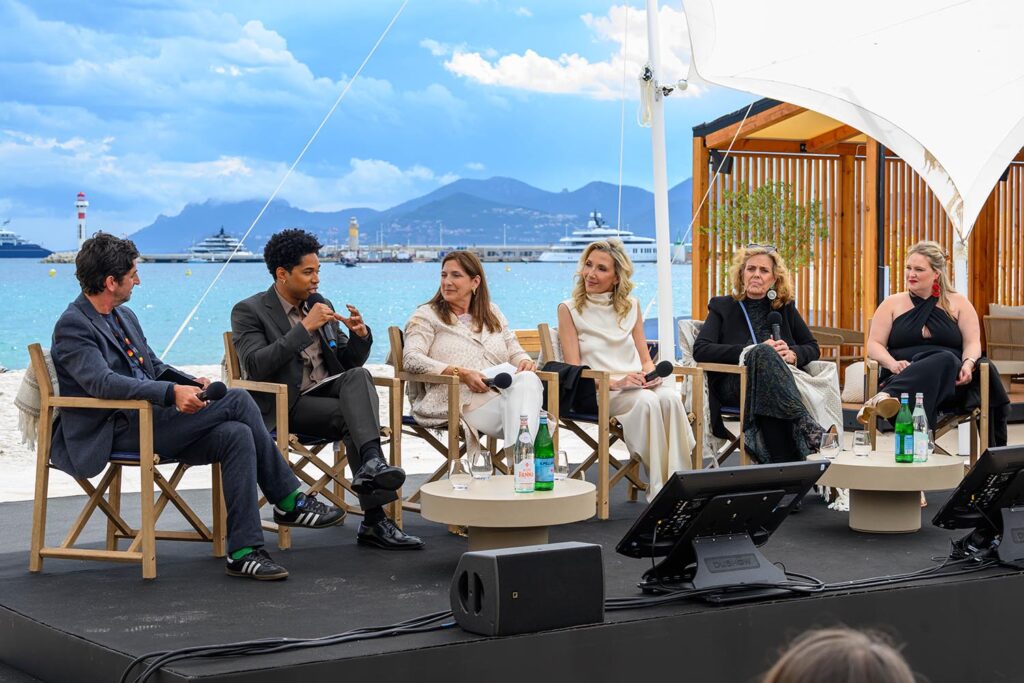
Helen Hoehne, the President of Golden Globes LLC, certainly left the door open to add the category during remarks she made during a panel at the Cannes Film Festival in May.
“Will we someday see a Best Documentary Award at the televised ceremony? President Hoehne said: “I think today is just the first step, for me at least, to celebrate this genre and really highlight the filmmakers.”
She went on to say, “Documentary changes the world … and I think especially in this turbulent time that we live, this is so essential.”
That’s a welcome sentiment to Carolyn Bernstein. As the Executive Vice President, Global Scripted Content and Documentary Films at National Geographic, she is also eager to see the genre in the spotlight of a high-profile awards show.
“As one of the major awards bodies in our industry with international membership and global reach and recognition, the Golden Globes is uniquely positioned to support globally relevant, nuanced, and visually splendid storytelling that represents the best of documentary filmmaking,’’ Bernstein said.
THE IMPORTANCE OF BEING SEEN
Historically, the Golden Globes Awards have only sporadically included a Best Documentary category, including from 1972-1977. But the moment seems within reach again.
A few days before last year’s telecast, directors Eugene Jarecki and Ross McElwee received bespoke trophies as recipients of the recently created Golden Globes Prize for Documentary, presented by Artemis Rising Foundation.
The landmark event celebrated “the shared commitment to the cultural and artistic impact of documentary storytelling,” according to Deadline. The presentation took place at the cocktail reception in Los Angeles on the Thursday night before the Sunday main event.
“There is an urgent need for non-fiction stories to be made, recognized and seen,” Scully said that night. “This prize is an extension of the work Artemis Rising Foundation has engaged in for decades to champion powerful stories about some of the most challenging social justice issues of our time; I hope it helps to push these incredible creative works further into the spotlight.”
But as profound as the moment was, it lacked the life-altering economic wallop that can come with winning a Golden Globe before a massive television audience.
That split second can fuel increased audience interest on streaming platforms, increased international press and propel a larger real-world impact.
“Awards recognition is one of the most important and succinct ways to convey to an audience that a film is of high quality and worth their time,’’ Bernstein said. “Without this ripple effect, it would be less viable for Nat Geo Doc Films to support this type of non-fiction storytelling.”
She noted that documentaries often take on under-reported or challenging topics. But films such as “The Cave,” “Bobi Wine: The People’s President” and “Sugarcane” broke through with audiences thanks to well-deserved bumps from the Oscars, the National Board of Review and the Critics’ Choice Awards.
Turkov has seen the same phenomenon. The validation that comes with a major award can exponentially amplify a documentary’s power. She calls it “the business of the double bottom line,” meaning that a financially successful nonfiction film can also make a great impact in the world.
“You could have the best United Nations campaign on democracy, but these stories are the ones that reach people’s hearts and minds,’’ she said. “They are artistically crafted and genuinely incredible, entertaining stories. They reach, I think, all communities in a way that helps people broaden their perspective.
“So, for me, awards campaigns have been a kind of fundamental part of the DNA of our business.”
The Geena Davis Institute knows firsthand about such impact. The 2019 documentary “This Changes Everything” emerged as a landmark examination of gender disparity in Hollywood. Geena Davis, the founder and chair of GDI, and Madeline Di Nonno, President & CEO of GDI, served as executive producers for the film, which continues to spark meaningful change.
A LEGACY OF MASTERPIECES
Clearly, the Golden Globe Foundation — as HFPA was rebranded in 2023, amid controversy – recognizes the power of the press. Last September, the philanthropic arm of the famed awards show donated $3 million in grants spread across 86 nonprofits. Among the recipients were journalism mentorship and training programs for organizations such as the Freedom of the Press Club, the National Hispanic Media Coalition and the National Press Club Freedom Center.
On the other hand, that only makes the lack of a Best Documentary at the Golden Globes more befuddling.
“People are looking to this genre more than ever. They’re so hungry for good information – non-biased information – that’s not bought and paid for,’’ Dreyfous said. “We’re bringing them good information, and then you decide for yourself. We’re not telling people how to think the way mainstream media is. Documentaries are just providing great information, and then people are left sovereign to make up their own minds.”
Scully and Dreyfous have teamed up on projects such as “The Invisible War” (2012), “The Hunting Ground” (2015) and “Won’t You Be My Neighbor?” (2018).
“Everybody is looking for their documentarians to really find out what’s going on in the world, not just locally in arts in our country, but all over the globe. That’s who they’re trusting right now – the storytellers and the documentarians,’’ she said. “I have so many friends who say, ‘Yes, you know, I watched a documentary on that.’
“And so the genre needs to be elevated to the status it holds in our world right now. Documentaries shouldn’t be treated like the poor cousins.”
MUSIC TO THE EARS – AND THE RATINGS?
To those who would argue that documentaries are too low-wattage for the Golden Globes red carpet, more than one of our filmmakers sang a different tune.
While the Golden Globes have a “Best Song” category, songs from documentaries aren’t eligible because documentaries aren’t. In the past two years, two doc songs were Oscar-nominated but omitted by the Golden Globes because they didn’t qualify.
Some of the shortlisted songs from the past decade came from performers such as Lady Gaga, Selena Gomez, Kesha, Sting, Dianne Warren, Pharrell Williams, Elton John and Brandi Carlile.
“So they’re missing opportunities to have people like Elton John or Lady Gaga on their show because they’re not recognizing documentaries,’’ Dreyfous said. “So we’re trying to make the case, the business case but also the moral case,’’ Dreyfous said. “We’re trying to make this be a win-win for everybody.”
A ‘GOLDEN’ OPPORTUNITY
Will it happen?
In the wake of the Cannes Film Festival’s new documentary prize, the Golden Globes have a chance to follow suit. And in this world of blurred lines between fact and fiction, it has never been more important to salute those who create art in the name of truth.
“At a time of rapid technological change and debate over what is fact vs. fiction,’’ Bernstein said, “The Golden Globes’ inclusion of the world’s best nonfiction stories and storytellers would be a critical and timely endorsement of the importance of freedom of expression and the power of journalism and democracy.”