
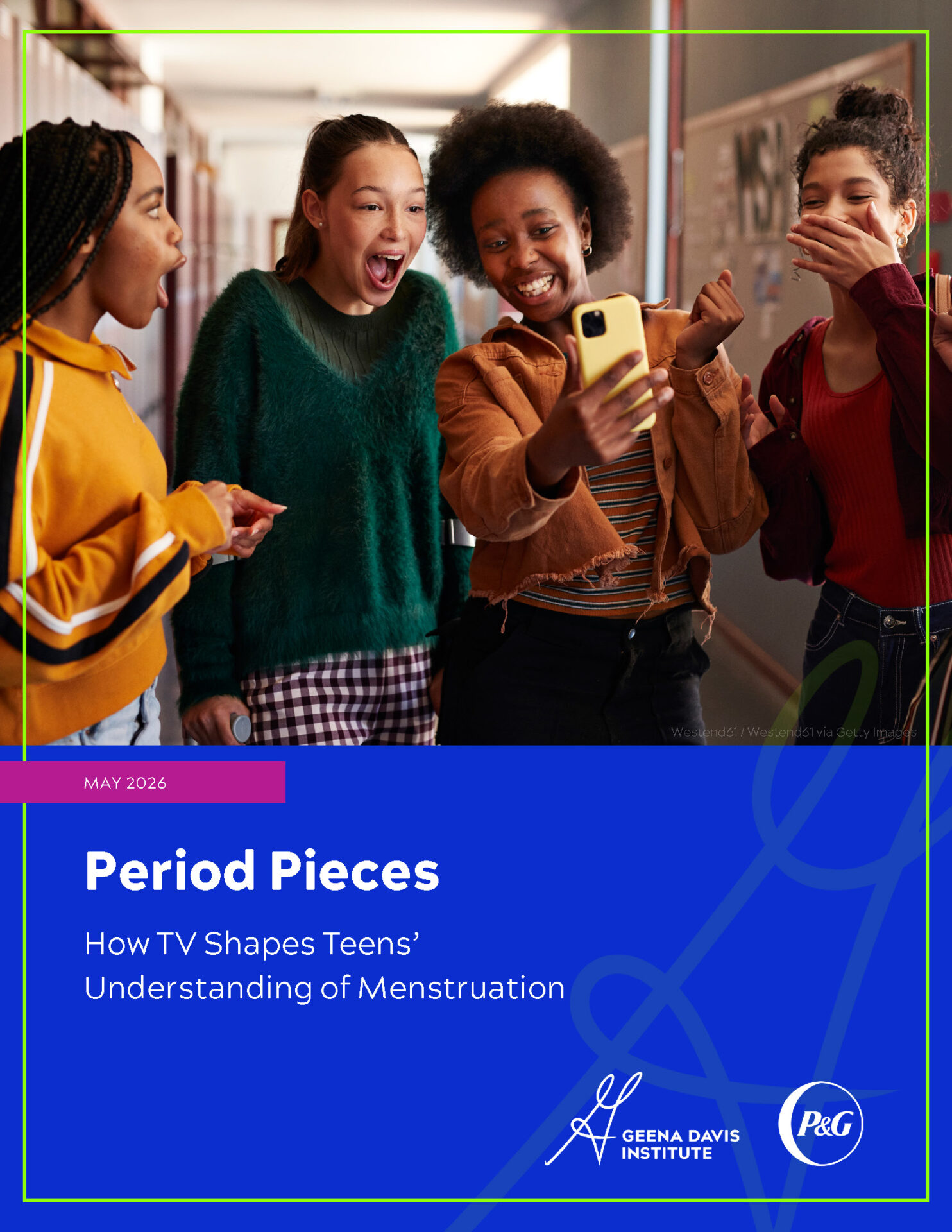

While teens engage with various sources of media — such as gaming, social media, and general internet browsing — television is still one of the most frequent types of media they are exposed to on a daily basis with the power to shape how they view menstruation.
Given television’s strong hold on teen audiences, researchers have invested substantial effort in examining its effects. Research consistently shows television has the power to directly influence teens’ behaviors, attitudes, and social learning. For instance, various studies illustrate that exposure to prosocial media is related to higher levels of prosocial behavior and empathy, and lower levels of aggression among viewers. Likewise, evidence suggests that identifying with favorite television characters is linked to a higher probability of young people adopting comparable workplace aspirations and values. These findings demonstrate that what is shown on screen has the power to influence real-world behaviors and attitudes among young audiences. These are just a few studies that demonstrate the power television portrayals have on young audiences.
The report, Period Pieces: How TV Shapes Teens’ Understanding of Menstruation, conducted by the Geena Davis Institute, examines how television shapes public understanding of menstruation — an issue often treated as confusing, embarrassing, or hard to talk about. Morevoer, the study examines whether media portrayals reinforce or challenge prevailing stigma.
Menstruation has long been treated as shameful or embarrassing. Girls and women are encouraged to keep menstruation private. Despite menstruation being relevant to all genders in all kinds of contexts — such as sex, conceiving, and menopause — discussing menstruation with men is even more discouraged. Psychologists explain that such an emphasis on secrecy around menstruation reinforces the idea that menstruation is shameful or embarrassing.
This study examines how real-world teens and parents perceive menstruation, how often it occurred in television scripts from 1950 to 2018, and the nature of how it appeared in teen programs in 2018 and 2024. Using survey data as well as textual and content analyses, following key points were found:
Key findings from surveying parent–teen pairs
- Teenage girls and boys get information from unique sources. Nearly all (95%) of teen girls learn about menstruation from their mothers, and 52% learn from friends. Teen boys rely more on school (68%) but also their mothers (47%). Entertainment media is a minor source, but teen boys cite it twice as often as teen girls (16% compared with 8%).
- Fathers are increasingly part of the conversation. Altogether, 19% of teens say they learned about menstruation from their fathers (26% of boys; 10% of girls) — a major jump from their parents’ generation, of whom 4% say they learned about it from their fathers.
- Parents and teens recall TV episodes about menstruation to be rare. Only 8% of parents and teens say they “often” or “somewhat often” see menstruation in shared media — far lower than other topics, like “plans for after high school” (53% parents; 48% teens) or “mental health” (46% parents; 51% teens).
- Media portrayals of menstruation do spark family conversations — when they appear. Altogether, 45% of parents and 40% of teens say menstruation on screen has prompted a discussion about the topic. Statistical analysis shows that seeing menstruation depicted or discussed on screen significantly increases the likelihood of parent–teen conversations.
- Parents and teens want period-related storylines that feel healthier and more grounded. Nearly half of teens (48%) and a clear majority of parents (57%) want depictions that aren’t traumatic or embarrassing; 55% in both groups want fewer jokes framing periods as gross.
- Teens respond positively when portrayals are relatable and realistic. In open-ended responses, teens praised depictions showing cramps, mood swings, anxiety about leaks, or supportive conversations, noting these moments make them feel “normal,” “understood,” and “less embarrassed.”
Teens rarely see menstruation in media and mostly learn about it from parents, school, and friends. When menstruation does appear on screen, it prompts family conversations, and both parents and teens want more realistic, non-embarrassing portrayals that reflect everyday experiences.
Key findings from longitudinal analysis of TV transcripts
- Menstruation is rarely referenced in TV transcripts. Across 59,313 English-language episode transcripts from 1950–2018, only 1.2% (688 episodes) included any menstruation-related terms.
- Mentions have increased in recent decades. References were virtually nonexistent through the 1960s, began to appear sporadically in the 1970s and 1980s, and rose most sharply in the 1990s, 2000s, and 2010s.
- Overall usage is trending upward. Product mentions and direct language increased across each decade since the 1970s, suggesting a gradual shift toward more open and explicit references on screen. The occurrence of euphemisms in transcripts for the past two decades are largely steady (but not increasing).
Menstruation has been largely absent from TV dialogue historically, appearing in just 1.2% of episodes from 1950–2018. References increased notably beginning in the 1990s, with more direct language and product mentions over time, suggesting a gradual shift toward openness rather than increased reliance on euphemisms.
Key findings from the analysis of teen television programming in 2018 and 2024
- Menstruation references in TV made for teens are extremely rare. Out of 313 teen-focused episodes analyzed, only 6% (n = 18) included any mention of menstruation, totaling 24 references. Most references were minor plot points.
- Menstruation references occured slightly less in 2024 than in 2018. Of the 24 references, 58% occurred in 2018 episodes and 42% in 2024 episodes, suggesting little change in frequency.
- Contextual placement is limited. Half of menstruation scenes occurred in bathrooms or locker rooms, while the other half appeared in other settings.
- Language is mostly explicit; euphemisms are minimal. Characters used terms like “period,” “tampon,” and “bleeding,” with euphemisms such as “shark week” or “monthly visitor” appearing infrequently.
- Stereotypes are mostly avoided. Only two characters were portrayed as overly emotional due to menstruation, and some narratives reframed menstruation positively or playfully (e.g., using a tampon to stop a nosebleed or to help read a magic spell).
- Opportunities for integration are frequently missed. While 47% of episodes featured sex, 44% featured sports, 18% featured pregnancy, 4% featured puberty, and 1% featured contraception, menstruation was largely absent from these contexts where it could naturally appear.
Menstruation is largely absent from teen TV, appearing in only 6% of episodes, with no increase from 2018 to 2024. When it does appear, references are brief, but explicit and rarely stereotypical, sometimes framed positively. However, its near-total absence is notable given how often related contexts like sex, sports, and pregnancy appear in teen television programming.
Recommendations
The survey’s findings illustrate the power of menstruation stories on screen can have to help facilitate parent–teen conversations. Despite this potential, menstruation portrayals in television designed for teens are uncommon, which can contribute to the stigma and mystification of menstruation in the real world.
These findings have resulted in the following recommendations to increase and improve the representation of menstruation on TV for teens:
- Period products can be authentic props. Consider bathrooms at home or in public spaces, locker rooms, or bedrooms as key settings where period products can be seamlessly integrated. Similarly, consider the placement of period products in backpacks, handbags, purses, lockers, drawers, or a suitcase for travel. This adds a subtle layer of relatability and can make characters feel more authentic.
- Ensure menstruation feels like a natural part of the storyline. When menstruation appears on screen, it should feel natural rather than forced or performative. Audiences engage most with a topic when it is woven into the storytelling, not presented as a public service announcement. Identify moments in your scripts where menstruation could enrich the story; key opportunities include plots involving sports, sex, or puberty. By adding menstruation subplots to these existing storylines, creators can normalize menstrual experiences while enhancing character depth and narrative authenticity.
- Understand menstrual tropes so stories reflect real experiences, not myths. Writers should be mindful of the period tropes outlined in this report. These long-standing clichés have often framed menstruation as dirty, embarrassing, or a joke, and have used it as an easy explanation for a character’s emotions or mood. Such portrayals flatten characters and reinforce outdated assumptions about women and girls. Humor can have a place in menstruation stories, but it should avoid positioning women as the punchline.
- Diversify menstruation storylines. Menstruation is a long-term part of many women’s lives, and its relevance extends far beyond pregnancy. Portray it as a broader health and life experience by exploring its role in relationships, stress, health concerns, and everyday responsibilities in school, work, and social settings. Broadening these contexts leads to more accurate and authentic on-screen stories. And as our survey data shows, these storylines can lead to more direct conversations about this topic between teens and their parents.
- Go beyond one-liners when portraying menstruation. Many of the menstruation references we identified were brief, with almost no integration into subplots or main storylines. Treat menstruation as a nuanced experience that can deepen character development. Rather than relying on quick mentions, expand these moments into scenes or exchanges that allow characters to respond with resonance, empathy, or meaningful acknowledgment.
How to cite this study:
Terán, L., and Conroy, M. (2026). Period Pieces: How TV Shapes Teens’ Understanding of Menstruation. Geena Davis Institute.