In a quest to discover and support emerging filmmakers, Jordan Peele, the modern master of psychological horror, posed an open question to artists about a year ago:
“What’s your biggest fear? What monsters lurk in the deepest corners of your inner thoughts?”
Peele clearly tapped into a deep well. The answers – more than 4,000 of them across 85 countries – came in the form of submissions to the Peele-inspired No Drama initiative.
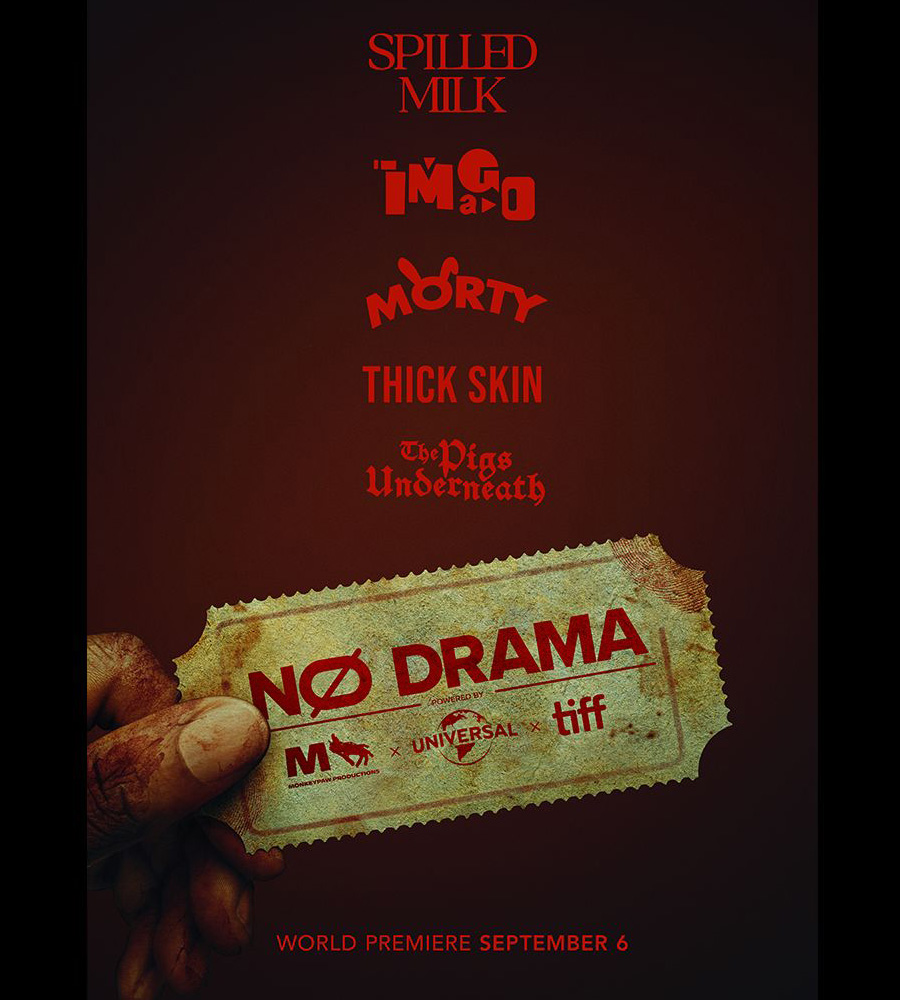
The goal of the initiative was to empower and elevate promising talent, and, on that front, No Drama hit the horror genre jackpot. Peele’s Monkeypaw Productions, in conjunction with Universal Film and the Toronto Film Festival, landed upon five brilliant filmmakers in need of a boost. Their cinematic shorts would go on to frighten the daylights out of audiences at TIFF in September with themes ranging from dystopian society to creepy technology to deadbeat dads and more.
“The films were rich with texture, they were innovative and really distinct to who they are as a storyteller,’’ said Emerlynn Lampitoc, Vice President, Filmmaker & Content Strategies for Universal Film. “Those scripts just stayed with us long after we turned that final page.”
But long before that, things kicked off with a delightful jump scare. When the inaugural class of No Drama filmmakers gathered for their first meeting with Peele, the participants looked around the room and developed an eerie feeling that this must be too good to be true. Had audiences been watching the meeting on screen, someone might have yelled, “Don’t go in there!”
Lampitoc recalls the scene vividly.
“I remember when they actually sat down with Jordan. And Jordan was like, ‘OK, I’m here to answer any of your questions,’” Lampitoc recalled. “And it was complete silence for like 3 seconds. You could hear a pin drop onto the carpet because I think they were all looking at him. I think they just could not believe they had Jordan Peele right in front of them.”
As it turns out, there was nothing to be afraid of. In fact, the whole point of the No Drama initiative was to demystify the filmmaking process and provide artists in need of resources with access to top industry professionals.
The results proved magical. The motto of the Geena Davis Institute is that “If they can see it, they can be it.” The No Drama initiative put that concept to the test by providing the resources to make dreams come true.
“It was game-changing for them,’’ said Keisha Senter, the Senior Vice President of Culture & Impact at Monkeypaw Productions. “The importance of No Drama and the power of the entire process was this ecosystem of partners at the table. There was Monkeypaw and what we brought to the table, as well as Universal and the powerhouse that they are.
“And then the TIFF part of the equation allowed for these films to be showcased and shared. To me, it was the ecosystem that differentiated this initiative.”
Welcoming the next generation

The five filmmakers were selected to create short films that explored horror across cultures, time, environments and society. Chandler Crump, Charlie Dennis, Helena Hawkes, Jared Leaf and Ariel Zengotita each received a $50,000 grant from TIFF to produce their projects during the one-year, non-exclusive program.
“Once we met them, we were, like, ‘These are our people,’’’ Senter said. “Their stories were fun. They were mischievous. They touched on issues that had universality.
“Because that is one thing with Monkeypaw, and our partners at Universal, we’re always thinking about, ‘How big is the story? What’s the connectivity? Who are the characters? Are the characters relatable?’”
That name – No Drama – is a double meaning that refers to “horror only” but also to “no stress” in the process. Peele has talked about the hurdles he faced transitioning from comedy to horror and wanted to create a smoother pathway for others.
Moreover, the No Drama filmmakers were essentially provided with a true studio experience as they engaged with Universal and Monkeypaw Productions to learn more about areas such as development, marketing and communication teams. The filmmakers also worked with industry leading external partners. For all five short films, Mathematic provided in-kind VFX, Company 3 provided in-kind audio and color finishing, Signature Post provided in-kind sound design, and Format provided in-kind music supervision, library use and licensing.
“We had a lot of high-level executives participating in the selection process,’’ Lampitoc, the Universal executive, said. “From reading scripts to support from our president of domestic marketing, Dwight Caines, whose team created one-sheets for each of the films and even put together a trailer with the same vendors that they use for our own theatrical films.
“People really leaned in and engaged with the filmmakers in the same way that they would engage with big-name filmmakers that we work with.”
Predictably, the No Drama class can barely process the surreal boost to their careers. So many hurdles, so many dead ends, suddenly gave way to a full-throttle breakthrough.
New perspectives bring nuanced stories to the horror genre
Charlie Dennis wrote and directed “The Pigs Underneath.” The tagline: Impoverished residents of a tight-knit dystopian community are forced to meet a brutal quota to survive. A young man and his mother are thwarted by theft, betrayal and the horrifying secrets of their desperate neighbors.
It’s one of the 12-to-14-minute films that made its world premiere in Toronto, amid red carpets and hoopla, and he can still barely believe it.
Of the No Drama platform, he said via email: “It’s given a seat at the table that’s not usually reserved for us, and said that we’re good enough. This can’t be understated – and it’s proven that our stories don’t have to be relegated to niche drama. I can sit in the cinema, allow these characters to become the heroes in their own stories and fight the villains up on the big screen. All in all – it’s changed everything for me, and I never want it to stop!!!”
Chandler Crump had a similar experience. The New York-based film director and writer is a graduate of NYU’s Tisch School of the Arts and will soon finish her Master of Studies in Creative Writing at the University of Cambridge.
Her No Drama entry, called “Morty,” centers on a teenage girl who gives her little brother a stuffed animal that comes with an online counterpart – then notices some sinister changes in his behavior.
Crump wrote via email, “No Drama enabled me to bring my vision to life without having to wear too many hats like most of us who come from the indie world are used to. The physical and emotional support was next level and has allowed me to grow so much as a director and collaborator.”
Helena Hawkes, a New Mexico native wrote and directed “Thick Skin.” It’s about a young woman so desperate to lose weight she winds up grappling with “the ravenous demons eating up her inside.”
“For me, No Drama was the ultimate bridge into the director’s chair … and not just any chair, but a studio director’s chair,’’ Hawkes said. “I’d been writing for years, but this initiative gave me the freedom and opportunity to step forward as a filmmaker in my own right after so much time facilitating others’ visions.
“Having access to world-class mentorship made me feel genuinely equipped to take on ‘Thick Skin’ with the care and sensitivity it deserved. It wasn’t just about getting a platform, it was about having the right guidance at the exact right moment, which allowed me to trust my instincts, stretch my voice, and claim my place as a storyteller in full.”
Jared Leaf’s film asked the question of what happened to all those deadbeat dads who went to the store to get milk and never came back. “Spilled Milk” follows a father’s innocent errand that quickly turns sour.
Leaf explained that he tends toward a premise that’s ridiculous on the surface, but ripe for becoming something deeply meaningful and entertaining.
“But No Drama didn’t shy away from that,’’ said the Portland, Ore.-based writer and director. “They leaned in. They provided me with education, tools, resources, and relationships that expanded what I thought I was capable of as a filmmaker. By providing a strong network of support and talented collaborators, they helped shape the story I wanted to tell in a way that never detracted from my voice — only amplified it.”
Ariel Zengotita is an award-winning filmmaker based in North Carolina, whose work tends to explore the space between psychological horror and dark comedy.
So, this was right up his alley. Zengotita short film contribution, “Imago” documents a daughter watching her mother transforming into an insect as their codependent relationship becomes unbearable.
“I truly believe that No Drama helped refine my voice down to the most effective version of itself, and I’m so grateful for the care and wisdom Monkeypaw, Universal, and TIFF put into the filmmakers involved,” Zengotita said. “Now I look back and wonder how much better my previous work would have been if I had a similar support system.”
No Drama, but plenty of potential
And how’s this for a happy ending? The first year of the No Drama program proved such a hit that there are already plans for more.
“I feel that something like this is important, because it also reminds me why I wanted to be in this business,” Lampitoc said. “We had this lean-in from the studio, and a lot of our executives said, ‘This is amazing. We should do this again!’ Because they saw themselves in these filmmakers starting out. So, knowing how we did this, it just supports the fact that this next generation of talent can come from anywhere.”
Senter, meanwhile, isn’t quite ready to say goodbye to the No Drama inaugural class. For these five horror movie visionaries, the best days are ahead.
It’s scary to think how good they can be.
“They’re part of the Monkeypaw family now, right?” Senter said. “And so we’re excited to just hear their ideas of what they want to write and what they want to do, and what their career looks like. We’re exploring ways to continue to work together.
“Now we know who they are, and we want to help them continue to become the filmmakers that they want to be.”
The next generation of storytellers are already rewriting the script. At the Geena Davis Institute, we’re proud to spotlight partnerships like No Drama that prove what’s possible when emerging voices are truly seen and supported.
Keep the Reel Turning: Support Emerging Storytellers
Love seeing programs like No Drama that open doors for emerging creators? Stay connected for more spotlights on the innovators shaping the future of film.
👉 Check out the No Drama trailer